Moduli of Curves II: I forgot my point!
Young tableaux are to planes as labeled trees are to curves. Continuing from the motivation of the previous post, we now dive into the structure of the moduli space $\overline{M}_{0,n}$, and construct two recursive structures that lead to beautiful inductive theory, and, in the next post, the construction of the space as a projective variety.
Let’s start with a definition of the noncompact interior $M_{0,n}$, also described in this combinatorial post on enumeration of trivalent trees.
Definition. The moduli space $M_{0,n}$, as a set, is the set of all isomorphism classes of choices of $n\ge 3$ distinct points $p_1,\ldots,p_n$ on the projective line $\mathbb{P}^1$, up to projective isomorphism.
Note that the $0$ in $M_{0,n}$ means “genus $0$”, as in, we are not choosing points on a torus, but on a genus $0$ Riemann surface.
Indeed, for the purposes of this post we will usually assume $\mathbb{P}^1$ is the projective line over $\mathbb{C}$, but our constructions here can work over any field, and we will draw them as if we are over $\mathbb{R}$, meaning that $\mathbb{P}^1$ can be represented as a circle. In other words, we are choosing locations of $n$ beads on a necklace up to a projective transformation. And note that a projective transformation is determined by where it sends three points (see my expository work on Schubert calculus for background on projective transformations) and so we may without loss of generality set $p_1,p_2,p_3$ to be at the points $\infty=(1:0)$, $0=(0:1)$, and $1=(1:1)$ and then the other points may vary freely. An example of a point in $M_{0,7}$, using this notation, is shown below in the rightmost picture:

We can notice right away that:
- $M_{0,3}$ has only one point, namely the unique choice of 3 points on $\mathbb{P}^1$ up to isomorphism, as shown above at left.
- $M_{0,4}$ can be thought of as the set of all choices of points $p_4\neq 0,1,\infty$, equivalent to $\mathbb{P}^1$ minus 3 points.
- $M_{0,5}$ can be thought of as the set of all distinct choices $p_4, p_5\neq 0,1,\infty$, equivalent to $\mathbb{P}^1\times \mathbb{P}^1$ minus some one dimensional loci of either point equal to $0,1,\infty$, or each other.
And so on. In order to make this a compact moduli space so that we can make a well behaved Chow ring on which we can do intersection theory and put the problems of the previous post on a rigorous foundation, we need to plug the holes and make a solid boundary!
The compactification $\overline{M}_{0,n}$
In order to compactify $M_{0,4}$ and plug up the three holes, the natural way to do so is to allow the fourth point to collide in some way with the other three points. The most natural way to do this in general is to define the more general class of stable curves as follows.
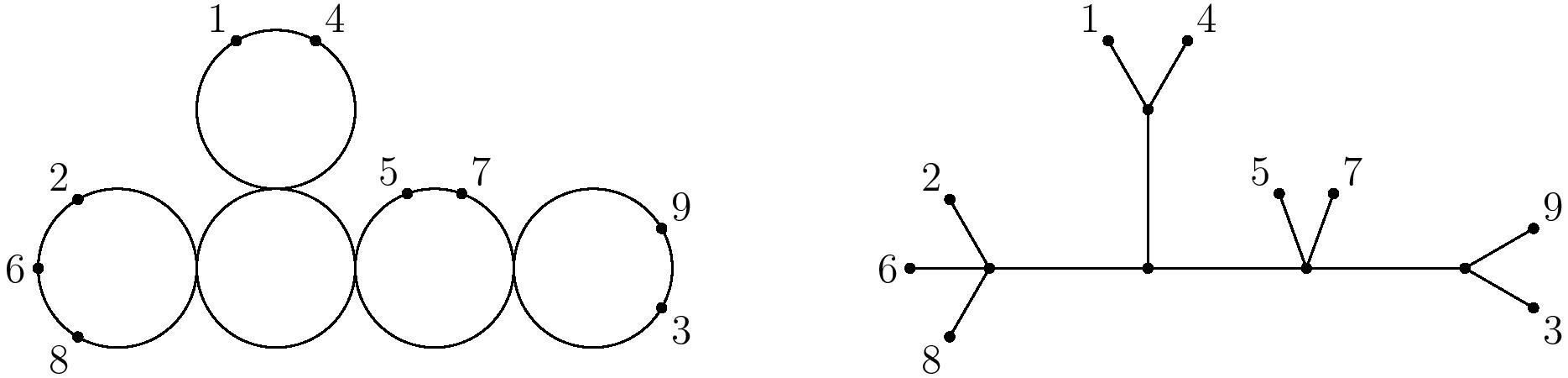
Definition. A stable curve of genus $0$ with $n$ marked points consists of a connected tree structure of $\mathbb{P}^1$’s glued at nodes, with $n$ marked points $p_1,\ldots,p_n$ chosen up to isomorphism, and distributed in such a way that the total number of nodes and marked points on each $\mathbb{P}^1$ is at least $3$.
Note here that the isomorphisms we are modding out by include symmetries of the tree as well as projective automorphisms on each $\mathbb{P}^1$. An example of a stable curve, and its dual tree are shown below, where the dual tree has an internal vertex for each $\mathbb{P}^1$ and a leaf for each marked point:
This compactifies the space $M_{0,n}$, which lies inside as the set of stable curves with just a single $\mathbb{P}^1$, by filling in the boundary. For instance, in $\overline{M}_{0,4}$, as the point $p_4$ approaches $p_3$ at coordinate $1$, the curve approaches the stable curve in which the $p_4$ and $p_1$ “bubble off” into their own component, attached to the original still at coordinate $1$:

Note that this corresponds to one of the “degenerate cases” in our conics picture from the previous post.
Let’s now look at $\overline{M}_{0,5}$ as a compactification of $M_{0,5}$. The missing locus at $p_4=p_5$, for instance, is filled by an entire one dimensional boundary stratum, including all the points that look like those in the upper left below:

and all further degenerations along this locus, namely the three “boundary” points in which we can think of the $4,5$ bubble as colliding with $1$, $2$, or $3$, as shown in the other three diagrams above. The four pictures above together form a boundary stratum, meaning the closure in $\overline{M}_{0,5}$ of the set of all curves with a given dual tree.
Recursive structure of the boundary
This construction gives rise to a remarkable self-similarity. The boundary stratum above, in which $1,2,3$ are on one component and $4,5$ on another, forms a one-dimensional space isomorphic to $\overline{M}_{0,4}\times \overline{M}_{0,3}$ within $\overline{M}_{0,5}$. As another example, the stratum shown below is a copy of $\overline{M}_{0,4}\times \overline{M}_{0,4}$, since there are two components with 4 marked points and the rest have three (and we can technically omit the copies of $\overline{M}_{0,3}$ in our products since they are just one point sets).
So, we can think of the boundary of $\overline{M}_{0,n}$ as made up of products of copies of other $\overline{M}_{0,r}$’s!
The strata also form a partial ordering by containment, and the combinatorial structure is quite interesting; here is a partial picture of the poset of dual trees for $\overline{M}_{0,6}$:

Each graded layer of the poset consists of all the dual trees with a fixed number of internal edges.
Combinatorial Challenge: Show that the alternating sum of the number of elements on each row of the poset above is $1-25+105-105=-24=-4!$. Can you show that the alternating sum, up to sign is $(n-2)!$ in general?
For a solution to this challenge and to simplifying other alternating sums arising in moduli spaces of curves, see my latest paper here with Vance Blankers and Jake Levinson.
I forgot my point: a universal tower
There is one more important recursive structure, using what are called the forgetting maps. For $n>3$, we can define the map
\[\pi_n: \overline{M}_{0,n}\to \overline{M}_{0,n-1} \]
as follows. Given a stable curve $C$, erase the marked point $n$ and, if its component had only three special points on it and became unstable with the deletion, collapse that component to a point. (Note that we can in fact forget any one of the marked points and then relabel, but for now we will focus on always deleting the $n$th marked point.)
Now, consider the preimage (also called the “fiber”) of any point $(C,p_1,\ldots,p_n)$ in $\overline{M}_{0,n-1}$. This consists of the set of all ways to add the $n$th marked point somewhere on $C$, including potentially colliding with a point or node and bubbling off into a component with three special points. Thus there is one point in $\pi^{-1}(C)$ for each geometric point of the curve $C$, and so the fiber is isomorphic to the curve itself!
This is what we call a universal family for a moduli space; it shows that via the forgetting map, $\overline{M}_{0,n}$ is the universal family over $\overline{M}_{0,n-1}$!
Indeed, we can chain these constructions together for all $n$ using a tower of forgetting maps all the way down to $ \overline{M}_{0,3}$, which is a single point:
\[\cdots \to \overline{M}_{0,6}\to \overline{M}_{0,5}\to\overline{M}_{0,4}\to\overline{M}_{0,3} \]
Beautiful!