What happens in characteristic p?
There is a reason that the real numbers and complex numbers are so popular. They have the nice property that $1+1+1+\cdots+1$ is not equal to zero, no matter how many times you add $1$ to itself.
Strange things happen in fields of prime characteristic $p\neq 0$, such as the field $\mathbb{Z}/p\mathbb{Z}$ of integers taken modulo $p$. In these fields, $1+1+\cdots+1=0$ for any number of $1$’s which is a multiple of $p$. We get non-intuitive but strangely beautiful identities like $(x+y)^p=x^p+y^p$, since the coefficient $\binom{p}{i}$ is divisible by $p$ for $1\le i\le p-1$.
And, we get a representation of the symmetric group which is indecomposable but not irreducible. Allow me to explain.
TeXStudio
First post in several weeks; term has hit. But in the midst of the hustle and bustle of the start of the semester, I’ve discovered a gemstone within the mathematical software world that was too good not to share: TeXStudio.
I discovered it while preparing for the “LaTeX Tricks” seminar this week, which I am organizing as part of the UC Berkeley Toolbox Seminar. (The seminar is looking to be quite exciting if you’re in the area - we will have a variety of speakers give 10-minute talks on their favorite LaTeX tool or package. It will be this Wednesday from 2:30-4PM in room 891 Evans Hall.)
Equilateral triangles in the complex plane
I came across an exercise in Ahlfors’ Complex Analysis the other day that got me thinking. The exercise asked to prove that the complex numbers $a$, $b$, and $c$ form the vertices of an equilateral triangle if and only if $a^2+b^2+c^2=ab+bc+ca.$ It struck me as quite a nice, simple, and symmetric condition.
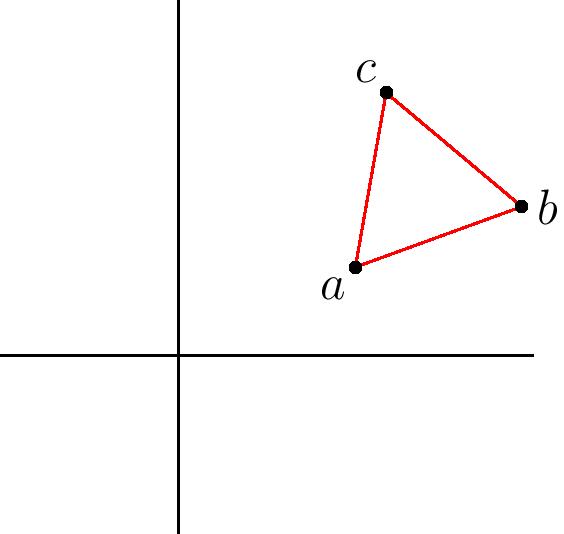
My first instinct, in going about proving this, was to see if the condition was translation invariant, so that one of the points can be moved to the origin. Indeed, if we subtract a constant $z$ from each of $a,b,c$ the equation becomes $(a-z)^2+(b-z)^2+(c-z)^2=(a-z)(b-z)+(b-z)(c-z)+(c-z)(a-z),$ which simplifies to the original equation after expanding each term. So, we can assume without loss of generality that $a=0$, and we wish to show that $0$, $b$, and $c$ form the vertices of an equilateral triangle if and only if $b^2+c^2=bc$.
The 3x+1 problem!
I have exciting news today: The first ever joint paper by Monks, Monks, Monks, and Monks has been accepted for publication in Discrete Mathematics.
These four Monks’s are my two brothers, my father, and myself. We worked together last summer on the notorious $3x+1$ conjecture (also known as the Collatz conjecture), an open problem which is so easy to state that a child can understand the question, and yet it has stumped mathematicians for over 70 years.
Summary: Symmetric functions transition table
Over the last few weeks I’ve been writing about several little gemstones that I have seen in symmetric function theory. But one of the main overarching beauties of the entire area is that there are at least five natural bases with which to express any symmetric functions: the monomial ($m_\lambda$), elementary ($e_\lambda$), power sum ($p_\lambda$), complete homogeneous ($h_\lambda$), and Schur ($s_\lambda$) bases. As a quick reminder, here is an example of each, in three variables $x,y,z$:
$m_{(3,2,2)}=x^3y^2z^2+y^3x^2z^2+z^3y^2x^2$
$e_{(3,2,2)}=e_3e_2e_2=xyz(xy+yz+zx)^2$
$p_{(3,2,2)}=p_3p_2p_2=(x^3+y^3+z^3)(x^2+y^2+z^2)^2$
$h_{(2,1)}=h_2h_1=(x^2+y^2+z^2+xy+yz+zx)(x+y+z)$
$s_{(3,1)}=m_{(3,1)}+m_{(2,2)}+2m_{(2,1,1)}$
Since we can usually transition between the bases fairly easily, this gives us lots of flexibility in attacking problems involving symmetric functions; it’s sometimes just a matter of picking the right basis.